

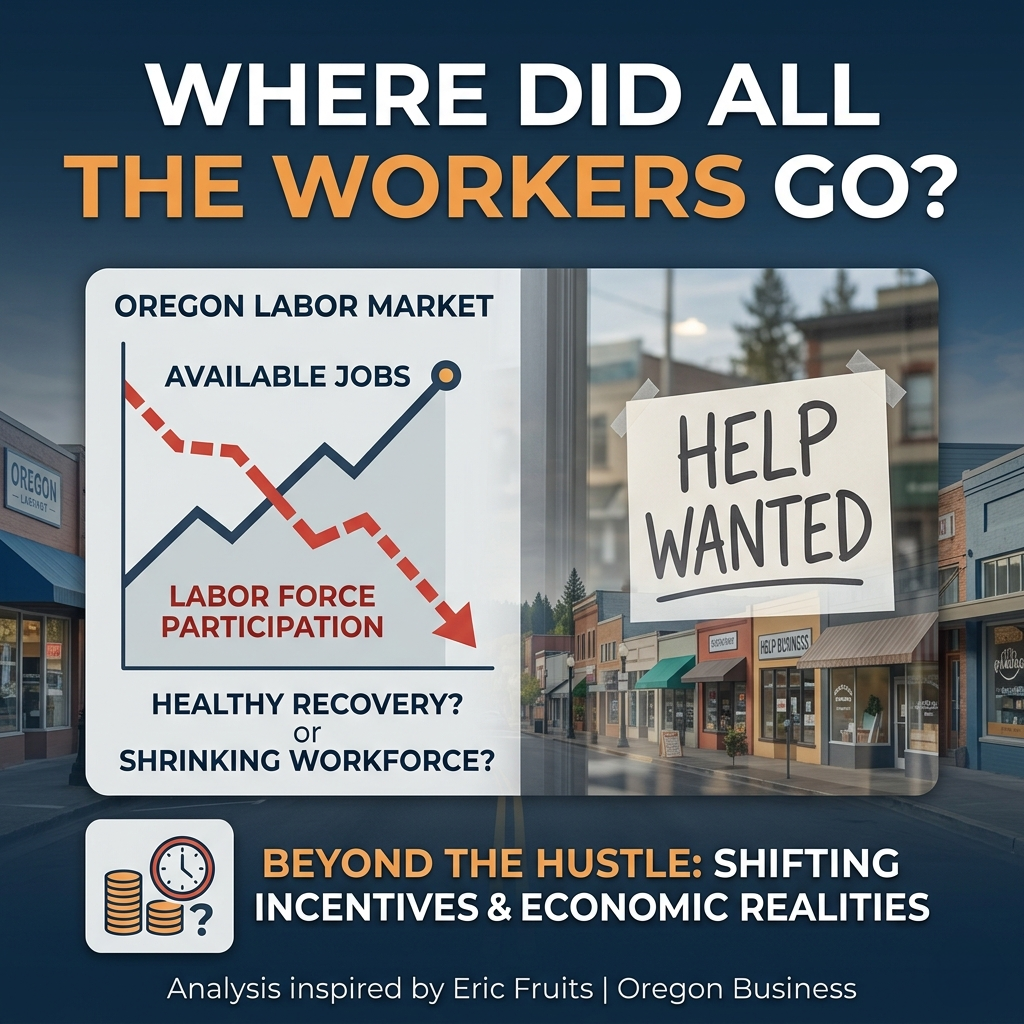
Where did all the workers go?
At first glance, Oregon’s labor market looks healthy. Job numbers have rebounded, businesses are open, and economic activity has largely normalized since the disruptions of the early 2020s. But beneath that surface-level recovery is a more troubling question:
Where did all the workers go?
The issue isn’t simply about unemployment, it’s about participation. Fewer people are choosing to work, or even engage in the labor market at all. That distinction matters. A low unemployment rate can mask a shrinking workforce, and that’s exactly what appears to be happening.
The Illusion of Recovery
Short-term job growth can create the impression of a strong economy, but it doesn’t necessarily reflect long-term stability. Over the past decade, Oregon has seen uneven income growth and stagnating labor force participation. In other words, even as jobs return, the share of people working, or willing to work, has not kept pace.
This isn’t just a statistical quirk. It has real implications for businesses struggling to hire, for productivity, and ultimately for the state’s economic trajectory.
Incentives Matter
At the core of the issue is a fundamental economic principle: people respond to incentives.
When the financial return from working diminishes, whether due to higher taxes, benefit cliffs, or rising costs of participation, fewer people enter the workforce. Oregon’s relatively high income tax structure plays a role here. For some workers, especially at the margin, the additional income earned from working more hours or taking a new job doesn’t justify the added burden.
Layer on top of that a regulatory environment that increases the cost of hiring, and you begin to see a system that quietly discourages both employers and employees.
A Shifting Economic Identity
Oregon has spent years positioning itself as a hub for innovation and the “creative class.” While that strategy has attracted talent in certain sectors, it may have come at a cost. Not every worker fits neatly into a high-skill, knowledge-based economy, and not every job can be replaced by one.
By emphasizing certain industries over others, the state risks sidelining segments of the workforce that are essential to a balanced economy, trades, service roles, and entry-level positions among them.
Structural, Not Temporary
It’s tempting to view today’s labor shortages as temporary, something that will resolve as conditions normalize. But the data suggests otherwise. These are structural shifts, driven by policy choices, demographic changes, and evolving incentives.
That distinction is critical. Temporary problems fix themselves. Structural ones require deliberate change.
What Comes Next
If Oregon wants to rebuild a more robust labor force, it needs to rethink the conditions that shape participation. That means looking beyond headline job numbers and focusing on the underlying dynamics:
Are people better off working than not working?
Are businesses incentivized to hire and expand?
Is the economy inclusive of a wide range of skills and occupations?
Answering those questions honestly may reveal that the issue isn’t a lack of jobs, it’s a lack of alignment between policy, incentives, and the realities of work.
Until that alignment improves, the question will remain:
Where did all the workers go, and what will it take to bring them back?